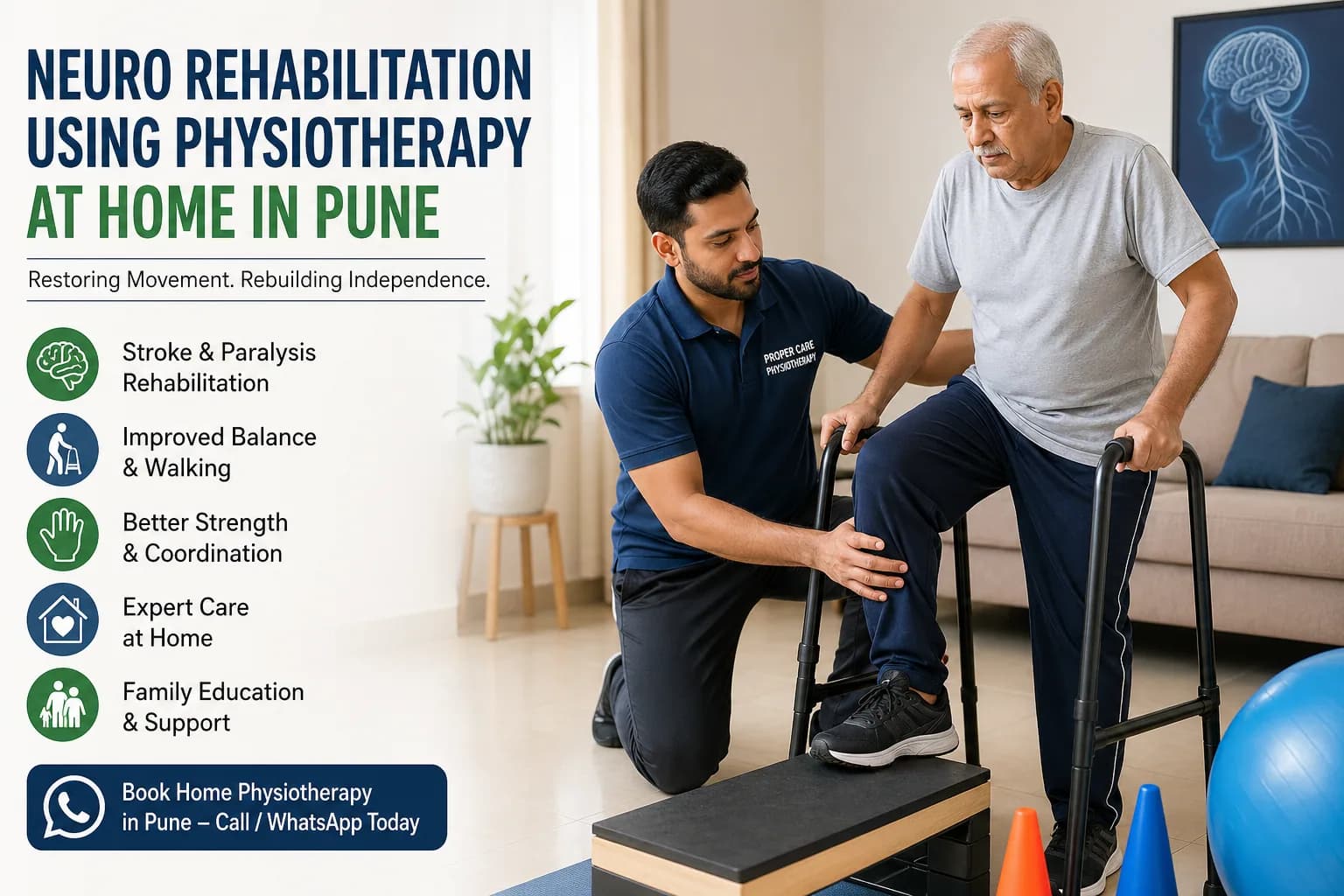
Best Paralysis Physiotherapist in Katraj: Expert Neuro Rehab
Reviewed by Dr. Krishna, Lead Consultant Physiotherapist at Proper Care Physiotherapy · Updated
Regaining Control: Finding the Best Paralysis Physiotherapist in Katraj
When sudden weakness hits, panic follows. A stroke. A spinal cord injury. A severe nerve block. Your world simply stops spinning. It crashes. We see this fear every single day. Families sitting in hospital waiting rooms or standing nervously in their own living rooms, wondering if their loved one will ever walk again. Will they hold a cup of tea? Will they speak clearly? We hear you. At Proper Care Physiotherapy, we don't just treat limbs. We rebuild lives. Right here in Katraj, we bring advanced neuro-rehabilitation directly to your home.
Paralysis is terrifying. There is no sugarcoating it. But it is rarely the end of the story. The human nervous system is stubbornly resilient. With the right input, the right timing, and the right physical guidance, recovery is entirely possible. But you cannot wait. Time is brain. Time is muscle. The longer a limb sits paralyzed, the harder the battle becomes.
The Magic Word: Neuroplasticity
As we always tell our patients, Let’s talk about neuroplasticity. Your brain is not a hard drive that gets permanently deleted. It’s a dense, chaotic, beautiful forest of connections. When a stroke wipes out a specific path—say, the path that tells your right hand to open—the brain can literally grow a new one. But it desperately needs directions. That is what neurophysiotherapy is.
We are essentially giving your nervous system the GPS coordinates to find a new route to your muscles. If an arm is paralyzed, the brain tries to forget it exists. It’s a defense mechanism called learned non-use. We force it to remember. Through repetitive, highly specific movements, we spark new synapses. We demand that the brain pay attention to the damaged side.
This isn't about simply lifting weights. Not at all. If you just give a stroke patient a dumbbell, they will cheat. Their brain will use the strong muscles to compensate for the weak ones. Our job is to block those compensations. We isolate the exact muscle firing patterns you lost and force you to relearn them, exactly like a baby learning to walk for the first time.
Understanding the Types of Paralysis We Treat
Honestly, Paralysis is a blanket term. As experienced physiotherapists, we need to know exactly what the underlying neurological deficit is. The treatment for a brain bleed is vastly different from the treatment for a severed nerve. Here in our Katraj practice, we handle highly complex neurological cases across the entire spectrum.
Hemiplegia (Stroke Recovery)
This is one-sided paralysis, usually caused by a stroke (CVA). In the early days following a stroke, a patient often enters a stage of flaccidity. The arm hangs heavy. The leg drags like a dead weight. Families often assume this is the permanent state. It rarely is.
Usually, muscle tone starts to return. But it returns wrong. This is called spasticity. The muscles lock up. The elbow bends tightly against the chest. The wrist curls inward. The toes point down in a stiff plantarflexion. If we don't intervene exactly here, you get permanent contractures. The joints freeze solid. Our first job in these stages isn't always strengthening. It’s alignment. It’s protecting the delicate joint capsule, especially the shoulder, from popping out of its socket.
Paraplegia and Tetraplegia (Spinal Cord Injuries)
Honestly, When the spinal cord is bruised or severed, the signals from the brain simply cannot travel down to the legs (paraplegia) or all four limbs (tetraplegia). These cases require intense, long-term dedication.
We focus heavily on wheelchair mobility, transfer training (getting from the bed to the chair safely), and preventing pressure sores. We use standing frames. We use calipers and specialized orthotics to get you upright. Weight-bearing through the long bones of the legs is absolutely key for bone density and bowel function, even if voluntary movement hasn't returned yet.
Bell’s Palsy (Facial Paralysis)
Waking up with half your face drooping is incredibly alarming. It mimics a stroke, but it is often just inflammation of the 7th cranial nerve. Bell's Palsy requires immediate, delicate physiotherapy. We use specialized facial massage techniques, neuromuscular electrical stimulation (if appropriate and carefully timed), and highly specific mirror feedback exercises to retrain the facial muscles to smile, blink, and chew symmetrically again.
The Proper Care Physiotherapy Approach: Step by Step
As we always tell our patients, You don't need a generic exercise sheet downloaded from the internet. You need a targeted, clinical assessment. When we walk into your home in Katraj for the very first time, we are looking at hundreds of tiny details.
We look at your posture in the bed. Are you leaning toward your strong side? We check your skin integrity. We test your reflexes. We grade your spasticity using the Modified Ashworth Scale. We test your proprioception—can you feel where your foot is in space without looking at it? If you can't feel it, how can we expect you to walk on it?
Once we have a complete clinical picture, we build the protocol.
1. Managing Tone and Spasticity
To put it simply, Stiff muscles cannot learn new tricks. We use prolonged stretching, weight-bearing techniques, and rhythmic rotation to break up abnormal synergy patterns. A synergy pattern is when you try to lift your arm, and your whole shoulder shrugs and your elbow bends involuntarily. We have to break that hardwired, faulty circuit.
2. The Bobath Concept (NDT)
Neurodevelopmental Treatment (NDT), often known as the Bobath concept, is a cornerstone of our paralysis rehab. It’s all about normal movement. We do not let you move abnormally. We facilitate the right muscles with our hands. We literally guide your pelvis, your shoulder blades, and your spine into the correct anatomical positions before asking you to take a step.
3. Proprioceptive Neuromuscular Facilitation (PNF)
This sounds complicated, but it’s a brilliant technique. PNF uses spiral and diagonal movement patterns that mimic natural human motion. We apply specific resistance to stimulate the nerve endings in your joints and muscles. It tricks the nervous system into firing stronger and faster. It is incredible for waking up dormant muscle groups.
4. Task-Specific Training
In our Pune clinic, we see this often. Lifting your leg on a bed is fine. But stepping over a threshold in your bathroom is functional. We practice real life. We will have you practicing reaching for a glass on your exact kitchen counter. We will practice getting in and out of your specific car. The brain learns best when the task has actual meaning.
5. Gait Training and Balance
Learning to walk again is a massive undertaking. We break it down into micro-components. Can you shift your weight? Can you lock your knee? Can you clear your toes without dragging them? We might use ankle-foot orthosis (AFO) splints to keep your foot from dropping. We guard you closely, preventing falls while pushing your balance systems right to the edge.
Why Home Visits Matter So Much in Katraj
We serve the entire Katraj area, from the main highway bypass down to Katraj Lake, up through the steep inclines of Ambegaon and the busy streets of Dhankawadi. Why do we insist on offering home visits?
In our Pune clinic, we see this often. Because a paralyzed patient should absolutely not be fighting Pune traffic just to get therapy.
Imagine the exhaustion of a stroke survivor. Simply getting dressed takes an hour of intense effort. Then getting into a rickshaw or a car. Then sitting in a clinic waiting room. By the time they actually reach the physiotherapy mat, their energy reserves are completely depleted. Their nervous system is fatigued. You cannot do high-level neuro-rehab on an exhausted brain.
When we come to your home, you are relaxed. You are in a familiar environment. Your energy is saved purely for the therapy itself. Plus,, it allows us to assess your real living space. We can point out trip hazards. We can show you exactly how to arrange the pillows on your specific bed to prevent bedsores. We can teach you how to navigate the steps outside your own front door. Clinic therapy is artificial. Home therapy is reality.
The Unsung Heroes: Caregiver Training
As we always tell our patients, If we treat the patient for one hour a day, who is managing the other twenty-three hours? The family.
Caregiver burnout is a massive, silent problem. Wives, husbands, sons, and daughters suddenly become full-time nurses. They injure their own backs trying to lift a paralyzed loved one. They get frustrated. They get scared.
A huge part of our job is training you, the family. We teach you ergonomic transfer techniques so you don't destroy your own spine. We show you exactly how to dress the paralyzed side safely. We teach you simple, passive range-of-motion exercises to do while watching TV. We empower you so you aren't just watching helplessly; you become an active, effective part of the rehabilitation team.
handling the Emotional Rollercoaster
In our Pune clinic, we see this often. Physical recovery is only half the battle. The psychological weight of paralysis is crushing. Depression is incredibly common following a stroke or spinal cord injury. Patients grieve the loss of their former lives. They get angry. They refuse to participate.
We understand this. A good neurophysiotherapist is part coach, part cheerleader, and part strict teacher. We know when to push hard and when to back off. We celebrate the tiny victories. Did a finger flicker today? That is a massive win. Did you sit unsupported on the edge of the bed for ten seconds longer than yesterday? We celebrate it. Progress in neuro-rehab is rarely a straight line upwards. It is a series of plateaus, small jumps, frustrating regressions, and eventual breakthroughs.
Nutrition and Hydration During Recovery
People rarely connect diet with physical therapy, but the connection is absolute. Repairing damaged nerves and building new brain pathways requires massive amounts of energy. A brain trying to reorganize itself burns calories rapidly.
As we always tell our patients, Plus,, swallowing difficulties (dysphagia) are common after strokes. If the patient isn't getting enough protein, they cannot rebuild muscle tissue. If they aren't hydrated, their tissues become rigid and prone to tearing. We work closely with the family to ensure the patient is in an best nutritional state to handle the physical demands we are placing on them.
Setting Realistic Timelines
Families always ask the same question first: "How long until they are normal again?"
Honesty is our policy. Anyone who promises a quick fix for paralysis is lying to you. Neurological recovery is a marathon, not a sprint. The fastest rate of recovery usually happens in the first three to six months. This is the golden window. The brain is highly malleable during this period.
To put it simply, However, the old medical myth that "whatever you haven't regained by six months is gone forever" is completely false. We have seen patients regain functional use of a hand two years after a stroke. We have seen spinal cord patients master new transfers five years post-injury. Progress absolutely slows down, but it rarely stops completely as long as the therapy continues.
You have to commit. It requires patience that will test your absolute limits. But the alternative is giving up, and that is not an option we entertain.
Final Thoughts on Your Journey Forward
Facing paralysis is facing a storm. But you do not have to walk through it alone. The right guidance changes everything. Whether it’s retraining a hand to write, teaching a leg to bear weight again, or simply finding a way to sit up without falling, the work starts today.
As we always tell our patients, If you or a loved one are dealing with paralysis in the Katraj area, reach out. Let’s evaluate the situation. Let’s build a complete, aggressive, and compassionate plan. At Proper Care Physiotherapy, we are ready to help you fight for every single inch of recovery. Your independence is worth the effort.